How to Get Ungated on Amazon Faster Without Guessing
Gating exists to keep counterfeit and unauthorized inventory off Amazon, not to keep small sellers out. Once you understand what Amazon's review team is actually checking for, ungating stops being a mystery and becomes a checklist. Here is what actually moves an application from pending to approved, why Amazon rejects an estimated 70 percent of first time DIY attempts, and why some sellers treat gated categories as their biggest advantage instead of their biggest obstacle.
Why gated categories are worth the friction
Most new sellers view gating as a wall to climb over as fast as possible and then forget about. Experienced sellers view it as a moat. A category like Grocery is gated precisely because it is harder to get into, which means fewer competitors bother, and the ones who do are more likely to be legitimate, authorized sellers rather than unauthorized resellers racing each other to the bottom on price. The friction that frustrates a beginner is the same friction that protects margin for the sellers who push through it. That reframing matters, because it changes how much effort is worth investing in doing this correctly the first time instead of treating it as a box to check.
Why a category or brand gets gated in the first place
Amazon restricts categories with a high history of counterfeit complaints, such as Grocery, Beauty, and Health & Personal Care, safety concerns such as Topicals and Supplements, or brands that have specifically requested restricted distribution, which covers most name brand electronics and many CPG brands. The common thread is that Amazon wants proof that whatever you are about to list is coming from a legitimate, traceable supply chain, not proof that you are a big seller.
Which categories are commonly gated in 2026
- Grocery and Gourmet Food. High opportunity, consistent repeat demand, moderate approachability.
- Beauty and Health & Personal Care. Strict due to safety and counterfeit history.
- Topicals and Supplements. Require additional compliance documentation on top of an invoice.
- Jewelry and Watches. Brand specific restrictions are common here.
- Automotive and Powersports parts. Often requires a certificate of authenticity from the manufacturer.
The one document that decides most applications: your invoice
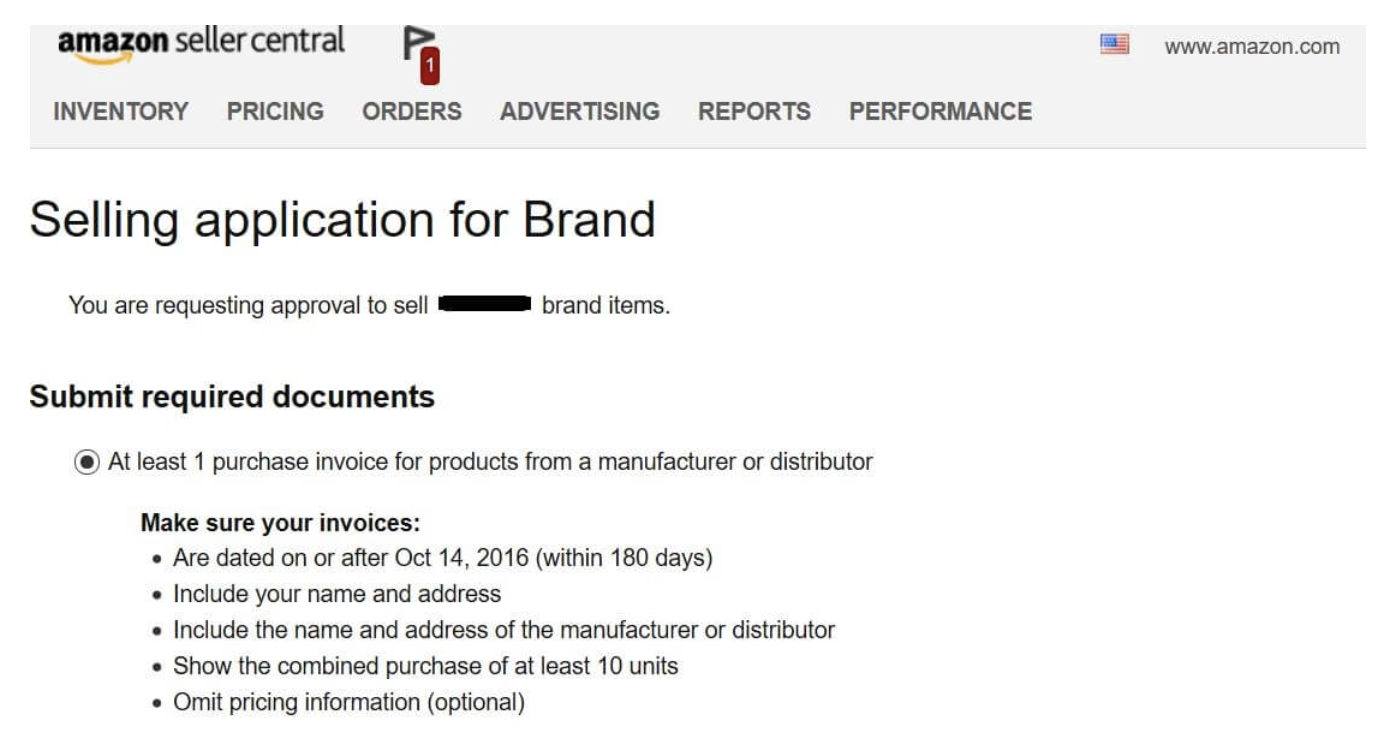
Amazon's ungating review is almost entirely invoice based. A strong invoice has your registered business name, the supplier's business name and contact information, the brand name as it appears on Amazon, matching UPCs for each product, and a purchase quantity that looks like a real wholesale order rather than a single retail purchase. Most reviewers want to see at least 10 units per SKU, dated within roughly the last 90 to 180 days. A blurry photo of a handwritten receipt, or an invoice from a retailer like Costco or Sam's Club, will almost always get rejected. Amazon wants an authorized distributor or the brand itself, not a retail purchase.
| Invoice must show | Why it matters |
|---|---|
| Your exact Seller Central business name | A mismatch is the single most common cause of rejection. |
| Supplier's business name, address, and contact info | Proves the source is a real, traceable business. |
| Brand name matching the Amazon listing exactly | Confirms you are sourcing the actual brand, not a lookalike. |
| Matching UPCs for each product | Ties the invoice directly to the ASIN you are applying against. |
| 10+ units per SKU, dated within roughly 90 to 180 days | Signals a real wholesale purchase, not a one off retail buy. |
Common rejection reasons and how to avoid each one
- Invoice does not match your Seller Central business name exactly. Register with a distributor using the same legal name on file with Amazon.
- UPCs on the invoice do not match the ASIN you are applying against. Double check before submitting, since one mismatch can sink the whole application.
- Quantity looks like a retail purchase, not wholesale. Most reviewers want to see at least 10 units per SKU, not a single unit.
- Invoice is too old. Stay inside the roughly 90 to 180 day window most categories expect.
- Supplier is not an authorized distributor for that brand. Ask for proof of authorization before you buy, not after you are rejected.
What sellers who breeze through ungating do differently
The sellers who get approved on the first try almost never have a better application template. What they have is a cleaner starting point: they only source from suppliers they already confirmed are authorized distributors, they register their business name identically everywhere from their LLC paperwork to their Seller Central account to their first purchase order, and they request invoices in a specific, wholesale friendly format before they even place the order rather than hoping whatever the supplier sends will work. In other words, they solve the ungating problem before they have a rejection to react to, not after.
A faster path: start with pre-vetted suppliers
The single biggest time saver in ungating is not a better application template. It is starting with suppliers who are already known to produce invoices that pass. This is why sourcing from authorized distributors matters more than chasing the cheapest price list you can find. It is also the exact reason Apex hands every new account 3 free, vetted, authorized US wholesale distributors on signup. You are not gambling on whether the invoice will hold up.
Ready to put this into practice?
Apex Black, Blue, Green & Red connect sourcing, purchasing, and profit tracking into one suite. Start your 7-day free trial, no card charged until it ends.
Start Free TrialOur real step by step for the Grocery category
Grocery is one of the highest opportunity gated categories in wholesale, with consistent repeat demand and less price erosion than trend driven categories, and one of the more approachable ones to get ungated in once you have the right invoice. We wrote a full walkthrough with real screenshots covering the exact steps, from finding the application inside Seller Central to what a passing invoice actually looks like, in our ungating guide.
The real cost of a rejected application
A rejection is not just an inconvenience. It has a real, measurable cost. Inventory that is already purchased and sitting at a prep center generates zero revenue while an application is pending, and every week it sits is a week of storage fees eating into margin that has not been earned yet. Worse, a rushed second attempt built on the same weak invoice often gets rejected again, doubling the delay. Sellers who build ungating into their process before the purchase order goes out, rather than after inventory has already landed, avoid this entirely. It is a small amount of upfront diligence against a real and avoidable cost.
What to do if you get rejected
A rejection is not final. It is feedback. Read the rejection reason carefully, since Amazon usually tells you exactly what was missing, fix that specific gap, and reapply. Do not reapply with the same invoice hoping for a different reviewer. Fix the actual issue first. Most second attempts succeed once the real problem, usually a name mismatch or an unauthorized supplier, is corrected. Apex University's playbook library includes a dedicated Ungating SOP and template Authorization Letter you can lean on when a category asks for more than a standard invoice.
Once you are ungated and sourcing real inventory, the next bottleneck is usually vetting which of the newly unlocked products are actually worth a purchase order. Our Keepa reading framework covers that next step.
How ungating differs from brand approval
Category gating and brand gating are related but distinct restrictions, and confusing the two wastes time. Category gating restricts an entire Amazon category, such as Grocery, regardless of which brand you want to sell within it, and clearing it once generally unlocks the whole category for future products. Brand gating restricts a specific brand regardless of category, meaning a brand can require its own separate approval even in a category that is otherwise open. A seller expanding into wholesale should expect to encounter both types over time, and keeping a running log of which categories and brands are already cleared saves real time on every new product evaluation.
Frequently asked questions about Amazon ungating
How long does Amazon ungating approval typically take?
Many applications with a clean, correctly formatted invoice are approved within minutes to a few hours. Applications that require manual review, or categories with additional compliance requirements such as Supplements, can take several business days. A rejected application effectively restarts this clock, which is the real cost of submitting a weak invoice the first time.
Can I get ungated without an invoice from an authorized distributor?
In most cases, no. Amazon's ungating review is built around verifying an authorized, traceable supply chain, and a retail receipt or an invoice from an unauthorized reseller almost never satisfies that requirement. There are limited alternative documentation paths for some categories, such as a letter of authorization directly from the brand, but these are harder to obtain than a standard wholesale invoice and should be treated as a backup option, not a first choice.
Does getting ungated in one category help with others?
Not directly. Each gated category and each gated brand requires its own approval. However, a track record of clean applications and an Amazon account in good standing does tend to make subsequent applications smoother, since your account history is part of what Amazon's automated review considers.
Is Amazon ungating the same as Amazon brand registry?
No. Brand registry is for sellers who own or are authorized to manage a brand's own listings on Amazon, typically private label sellers. Ungating is the separate approval process wholesale sellers go through to be allowed to list existing products in a restricted category or under a restricted brand they do not own. A wholesale seller generally never needs brand registry for the products they are reselling.
Ready to put this into practice?
Apex Black, Blue, Green & Red connect sourcing, purchasing, and profit tracking into one suite. Start your 7-day free trial, no card charged until it ends.
Start Free Trial