Automating Amazon Review Requests the Right Way
Reviews are the single biggest trust signal a new listing has, and also one of the easiest things to get wrong. Amazon has shut down entire seller accounts over review manipulation, so before automating anything, it is worth being precise about what is actually allowed, and honest about what a listing with no reviews is quietly costing you every single day it stays that way.
What a listing with zero reviews actually costs you
Shoppers do not read the description of an unfamiliar product before they check the review count. It is the fastest trust shortcut on the entire page, and a listing sitting at zero reads as a red flag regardless of price, photos, or how good the product actually is. That translates directly into a lower conversion rate, which lowers sales velocity, which is one of the inputs Amazon's own ranking algorithm weighs when deciding how often to show your listing at all. A slow start on reviews does not just cost you a few sales in week one. It can quietly suppress how much organic traffic that listing ever earns, which is why the sellers who take review requests seriously from day one tend to pull ahead of otherwise identical competitors within the first two months.
What Amazon actually prohibits
- Offering money, free products, or discounts in exchange for a review. This is banned outright, no matter how it is worded.
- Asking only customers you expect to leave a positive review, or filtering out unhappy customers from requests.
- Reviews from friends, family, or employees, disclosed or not.
- Any incentive tied to leaving a positive review specifically, versus a review in general.
What Amazon actually allows and encourages
Amazon's own Request a Review button exists precisely because a neutral, unconditional request for feedback is fine. The rule that matters is that you can ask every customer for a review, with no incentive, no cherry picking, and no expectation management about what they should say. That is the entire compliant playbook. The only thing automation should be doing is removing the manual work of clicking that button, or sending that neutral request, for every single order, on a consistent schedule, without you having to remember to do it.
Compliant request versus what gets accounts suspended
| Compliant | Not compliant |
|---|---|
| We would love your honest feedback on your recent order. | Leave us a 5 star review and get a $5 gift card. |
| Sent to every customer, every order | Sent only to customers who did not complain or return the item |
| No incentive of any kind attached | Free replacement or discount offered in exchange for a review |
| Neutral tone, no expectation set | If you're happy, please leave 5 stars |
The timing that actually improves response rates
Requesting too early, before the customer has had time to use the product, or too late, after the moment has passed and the order is forgotten, both hurt response rates. For most physical products, a request timed a few days after estimated delivery, enough time to actually try the product but while it is still top of mind, performs best. This is exactly the kind of consistent, well timed request that is easy to design once and painful to execute manually order after order.
What sellers with consistently strong review velocity do differently
The sellers whose listings accumulate reviews fastest are not doing anything Amazon would object to. They are simply more disciplined about the boring part: every order gets a request, every time, on a fixed schedule, with zero exceptions for orders that felt risky or customers who seemed unhappy. That consistency is what compounds. A seller who manually remembers to request reviews maybe 60 percent of the time is leaving 40 percent of their potential social proof on the table, and that gap widens every month the habit stays inconsistent.
Ready to put this into practice?
Apex Black, Blue, Green & Red connect sourcing, purchasing, and profit tracking into one suite. Start your 7-day free trial, no card charged until it ends.
Start Free TrialMetrics worth actually tracking
- Request send rate: what percentage of eligible orders actually got a request sent.
- Review velocity: new reviews per week on a given listing, especially in the first 60 days.
- Response rate over time: a sudden drop can flag a delivery or fulfillment issue worth investigating.
How Apex approaches this
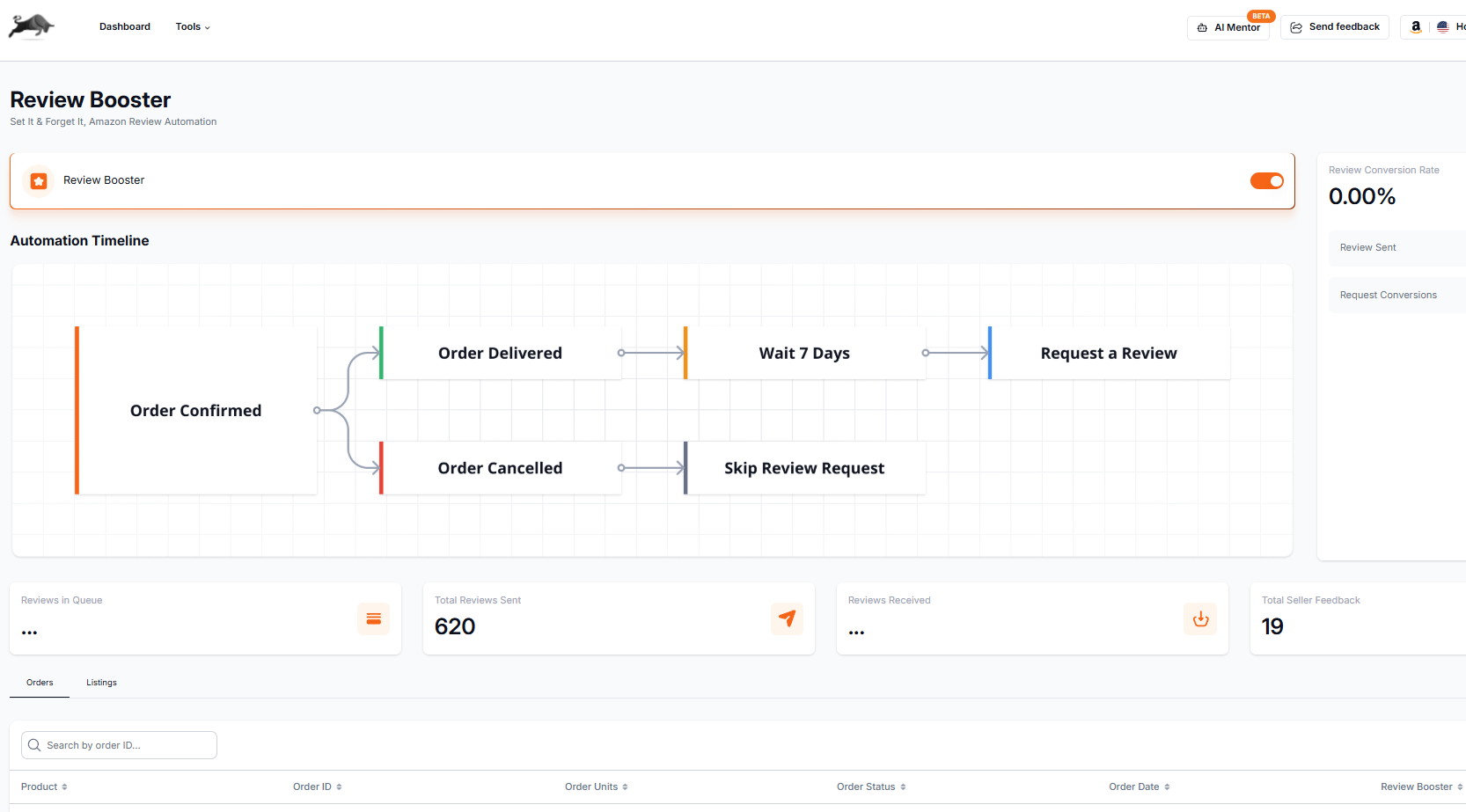
Apex Black includes Review Booster, free for life on every plan, specifically built around Amazon's compliant request framework: neutral, unconditional, automatically timed per order, with no discounts or incentives baked in anywhere. The goal is not to manufacture reviews. It is to make sure every legitimate customer who would have left one actually gets asked, without you manually tracking order dates in a spreadsheet.
How review count and rating actually influence Amazon's search ranking
Amazon has never published the exact weighting of reviews in its ranking algorithm, but the mechanism is well understood indirectly. Reviews influence conversion rate, and conversion rate is one of the clearest signals Amazon's system uses to decide how much organic traffic a listing deserves relative to competing listings for the same search term. A listing that converts better sells more per impression, which Amazon interprets as a better match for that customer search, which in turn earns more impressions going forward. This is why review velocity in the first weeks of a new listing has outsized long term impact. It is not that reviews are a direct ranking input, it is that they drive the conversion signal that is.
Frequently asked questions about Amazon review automation
Is it legal to automate Amazon review requests?
Yes, provided the automation only sends neutral, unconditional requests to every customer equally, matching what Amazon's own Request a Review feature does. Automation becomes a problem only when it is used to filter which customers get asked, or to attach any kind of incentive to the request.
How many reviews does a new Amazon listing need to start converting well?
There is no hard threshold, but the jump from zero reviews to even ten to twenty reviews tends to produce the most noticeable improvement in shopper trust and conversion rate. Beyond that range, additional reviews still help, but the marginal impact per review gradually decreases as the listing already has enough social proof to clear the initial trust bar.
What should I do if a customer leaves a negative review?
Do not attempt to have it removed unless it violates Amazon's content policies, such as containing profanity or being about the wrong product entirely. Amazon allows sellers to publicly respond to reviews, and a calm, helpful response to a legitimate complaint often does more for shopper trust than the negative review itself does damage. What you should never do is offer compensation in exchange for removing or revising the review, which is treated the same as any other incentivized review violation.
Ready to put this into practice?
Apex Black, Blue, Green & Red connect sourcing, purchasing, and profit tracking into one suite. Start your 7-day free trial, no card charged until it ends.
Start Free Trial